
Dynamic, Absolute and Kinematic Viscosity
Definitions and conversions between dynamic, absolute and kinematic viscosity.
Overview
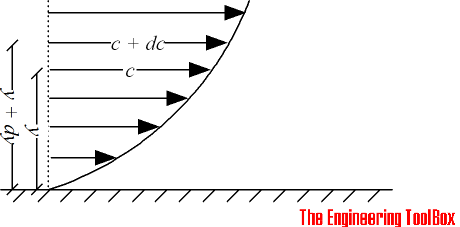
Viscosity quantifies a fluid's internal resistance to flow. When adjacent layers of fluid move at different velocities, inter-molecular friction generates shear stress. Two related measures capture this behavior:
- Dynamic (absolute) viscosity () — the tangential force per unit area needed to move one horizontal plane relative to another at unit velocity while maintaining unit separation.
- Kinematic viscosity () — the ratio of dynamic viscosity to fluid density, expressed without force units.
Both quantities depend strongly on temperature; any viscosity value is meaningless without a reference temperature.
Key Formulas
Newton's Law of Friction
For a Newtonian fluid in laminar flow, the shear stress between fluid layers is proportional to the velocity gradient:
where is shear stress (Pa), is the velocity gradient perpendicular to flow (1/s), and is dynamic viscosity (Pa·s).
Rearranging gives the definition of dynamic viscosity:
Kinematic Viscosity
Kinematic viscosity is obtained by dividing dynamic viscosity by mass density:
Other Viscosity Units
Dynamic viscosity is commonly expressed as Pa s, N s/m², poise, centipoise, lbm/(ft s), or lbf s/ft². Kinematic viscosity is commonly expressed as m²/s, Stokes, centiStokes, ft²/s, in²/s, or Saybolt Universal Seconds for petroleum products.
Newtonian Fluids
Newtonian fluids have a constant viscosity at a given temperature and pressure. The shear stress is directly proportional to the velocity gradient.
Shear-thinning or Pseudo-plastic Fluids
Shear-thinning fluids decrease in apparent viscosity as shear rate increases.
Thixotropic Fluids
Thixotropic fluids decrease in viscosity over time when sheared and recover partly or fully when left at rest.
Dilatant Fluids
Dilatant or shear-thickening fluids increase in apparent viscosity as shear rate increases.
Bingham Plastic Fluids
Bingham plastic fluids resist flow until a yield stress is exceeded, then flow approximately like a viscous fluid.
Measuring Viscosity
Dynamic viscosity is commonly measured with rotational viscometers, falling-ball viscometers, and capillary methods. Kinematic viscosity is often measured with calibrated capillary or efflux viscometers such as Saybolt instruments.
Imperial Conversion
When converting from centipoise and specific weight (lb/ft³) to kinematic viscosity in ft²/s:
Variables
| Symbol | Description | SI Unit |
|---|---|---|
| Dynamic (absolute) viscosity | Pa·s | |
| Kinematic viscosity | m²/s | |
| Fluid mass density | kg/m³ | |
| Shear stress | Pa | |
| Velocity gradient | 1/s | |
| Specific weight | lb/ft³ |
Quick Calculator
Kinematic Viscosity from Dynamic Viscosity and Density
Default values approximate water at 20 °C — adjust inputs for other fluids.
Example - Air, Convert between Kinematic and Absolute Viscosity
The source example for air is preserved explicitly here. For air with absolute viscosity approximately 1.983e-5 Pa s and density approximately 1.205 kg/m3, the kinematic viscosity is:
That is approximately 16.5 cSt because 1 m2/s = 1,000,000 cSt.
Dynamic Viscosity Unit Converter
Kinematic Viscosity Unit Converter
Unit Conversions
Dynamic Viscosity
| Unit | Equivalent |
|---|---|
| 1 Pa·s | 1 N·s/m² = 1 kg/(m·s) |
| 1 Pa·s | 0.67197 lbm/(ft·s) |
| 1 Pa·s | 0.02089 lbf·s/ft² |
| 1 poise (P) | 0.1 Pa·s = 1 g/(cm·s) = 1 dyne·s/cm² |
| 1 centipoise (cP) | 0.001 Pa·s = 1 mPa·s |
Reference: Water at 20.2 °C (68.4 °F) has a dynamic viscosity of 1 cP.
Kinematic Viscosity
| Unit | Equivalent |
|---|---|
| 1 stoke (St) | 10⁻⁴ m²/s = 1 cm²/s |
| 1 centistoke (cSt) | 10⁻⁶ m²/s = 1 mm²/s |
| 1 m²/s | 10⁶ cSt |
Reference: Water at 20 °C has a kinematic viscosity of approximately 1.0 cSt.
Viscosity of Common Liquids
Liquid | Absolute Viscosity(Pa·s) |
|---|---|
| Air | 0.00001983 |
| Water | 0.001 |
| Olive Oil | 0.1 |
| Glycerol | 1 |
| Liquid Honey | 10 |
| Golden Syrup | 100 |
| Glass (molten) | 1e+40 |
Source: engineeringtoolbox.com
Kinematic Viscosity vs. Saybolt Seconds
Kinematic Viscosity(cSt (mm²/s)) | Saybolt Universal Seconds(SSU) | Typical Liquid |
|---|---|---|
| 0.1 | — | Mercury |
| 1 | 31 | Water (20 °C) |
| 4.3 | 40 | Milk; SAE 20 Crankcase Oil; SAE 75 Gear Oil |
| 15.7 | 80 | No. 4 Fuel Oil |
| 20.6 | 100 | Cream |
| 43.2 | 200 | Vegetable Oil |
| 110 | 500 | SAE 30 Crankcase Oil; SAE 85 Gear Oil |
| 220 | 1000 | Tomato Juice; SAE 50 Crankcase Oil; SAE 90 Gear Oil |
| 440 | 2000 | SAE 140 Gear Oil |
| 1100 | 5000 | Glycerine (20 °C); SAE 250 Gear Oil |
| 2200 | 10000 | Honey |
| 6250 | 28000 | Mayonnaise |
| 19000 | 86000 | Sour Cream |
Source: engineeringtoolbox.com
Kinematic Viscosity vs. Saybolt Universal Seconds
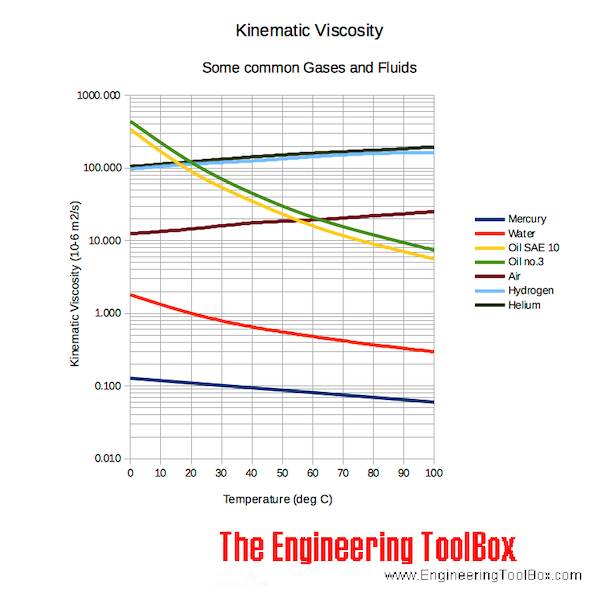
Kinematic Viscosity vs. Temperature
The original source includes a chart image for kinematic viscosity as a function of temperature. The interactive chart below preserves representative curve readings for common fluids and gases so the trends can be inspected numerically; use manufacturer data for design-critical interpolation.
Representative Kinematic Viscosity vs. Temperature
Fluid Behavior Types
Not all fluids follow Newton's linear stress–strain-rate law. Several categories describe non-Newtonian behavior:
| Type | Behavior | Examples |
|---|---|---|
| Newtonian | Shear stress is linearly proportional to shear rate (). Viscosity is constant regardless of applied stress. | Water, air, mineral oils |
| Shear-thinning (pseudo-plastic) | Viscosity decreases with increasing shear rate. | Paint, blood, polymer solutions |
| Thixotropic | Viscosity decreases over time under constant shear rate; partially recovers at rest. | Yogurt, drilling mud, some paints |
| Dilatant (shear-thickening) | Viscosity increases with increasing shear rate. | Wet sand, cornstarch suspensions |
| Bingham plastic | Behaves as a solid until a yield stress is exceeded, then flows with a roughly constant viscosity. | Toothpaste, mayonnaise, sewage sludge |
Restored Original Source Tables
The following tables are restored from the original source page to preserve the complete reference data.
Liquids - Absolute Viscosities
Liquid | Absolute Viscosity*) (N s/m2, Pa s) |
|---|---|
| Air | 1.983×10⁻⁵ |
| Water | 10-3 |
| Olive Oil | 10-1 |
| Glycerol | 100 |
| Liquid Honey | 101 |
| Golden Syrup | 102 |
| Glass | 1040 |
Source: engineeringtoolbox.com
Common Liquids - Viscosities
centiStokes (cSt, 10-6 m2/s, mm2/s) | Saybolt Second Universal (SSU, SUS) | Typical liquid |
|---|---|---|
| 0.1 | Mercury | |
| 1 | 31 | Water (20 oC) |
| 4.3 | 40 | Milk SAE 20 Crankcase Oil SAE 75 Gear Oil |
| 15.7 | 80 | No. 4 fuel oil |
| 20.6 | 100 | Cream |
| 43.2 | 200 | Vegetable oil |
| 110 | 500 | SAE 30 Crankcase Oil SAE 85 Gear Oil |
| 220 | 1000 | Tomato Juice SAE 50 Crankcase Oil SAE 90 Gear Oil |
| 440 | 2000 | SAE 140 Gear Oil |
| 1100 | 5000 | Glycerine (20 oC) SAE 250 Gear Oil |
| 2200 | 10000 | Honey |
| 6250 | 28000 | Mayonnaise |
| 19000 | 86000 | Sour cream |
Source: engineeringtoolbox.com
Original Source Images
The following original source images are preserved to avoid losing visual reference material. When an image contains chart or tabular data, its extracted values are represented in the page tables, calculators, or interactive charts; remaining images are retained as visual source references.
Engineering Notes
- Temperature is critical. For liquids, viscosity decreases as temperature rises. For gases, viscosity increases with temperature. Always report or look up viscosity at a specified temperature.
- Reference temperatures in ISO 8217: Residual fuels are characterized at 100 °C; distillate fuels at 40 °C.
- Selecting the right viscosity type. Use dynamic viscosity when calculating shear forces, pressure drops, or drag. Use kinematic viscosity for open-channel flow, lubrication specifications, and fuel grading.
- Unit consistency. Mixing SI and imperial viscosity units is a common source of error. When using the kinematic viscosity formula , ensure both and use consistent unit systems.
- Glass viscosity. The extremely high viscosity listed for glass reflects near-solid amorphous behavior at room temperature; molten glass at processing temperatures (1000–1400 °C) has viscosities many orders of magnitude lower.
- Measurement methods. Dynamic viscosity is commonly measured with rotational viscometers (Brookfield, cone-and-plate). Kinematic viscosity is measured with capillary (Ubbelohde, Cannon-Fenske) or efflux (Saybolt, Redwood) viscometers.