
Heat Exchanger LMTD Method
Log Mean Temperature Difference (LMTD) method for heat exchanger design and analysis.
Overview
The Log Mean Temperature Difference (LMTD) method is a standard approach for evaluating heat transfer in heat exchangers. It provides an effective mean temperature difference that accounts for the variation in driving force along the exchanger length, assuming a constant overall heat transfer coefficient.
According to Newton's Law of Cooling, heat transfer rate is related to the instantaneous temperature difference between hot and cold media. In a heat transfer process the temperature difference varies with position and time.
The mean temperature difference in a heat transfer process depends on the direction of fluid flows involved in the process. The primary and secondary fluid in a heat exchanger may flow in the same direction as parallel or co-current flow, in opposite directions as counter-current flow, or perpendicular to each other as cross flow.
Key Formulas
The LMTD is defined by the equation:
where (\Delta T_1) and (\Delta T_2) represent the temperature differences at the two ends of the heat exchanger. The total heat transfer rate (Q) is then calculated as:
Variables
Symbol | Description | Unit |
|---|---|---|
| ΔT1 | Temperature difference at one end | °C |
| ΔT2 | Temperature difference at the other end | °C |
| ΔT_lm | Log mean temperature difference | °C |
| U | Overall heat transfer coefficient | W/(m²·K) |
| A | Heat transfer area | m² |
| Q | Heat transfer rate | W |
Source: engineeringtoolbox.com
Arithmetic and Logarithmic Mean Temperature Difference Calculator
The original page includes an online calculator for arithmetic and logarithmic mean temperature difference in counter-flow and parallel-flow heat exchangers. Use counter-flow when the hot and cold fluids move in opposite directions, and parallel-flow when both fluids enter from the same end.
This calculator implements both original calculation scenarios. In counter-flow mode it uses and . In parallel-flow mode it uses and . It returns both AMTD and LMTD from the same input temperatures.
AMTD and LMTD calculator
Unit Converter
LMTD Unit Converter
Logarithmic Mean Temperature Difference Chart
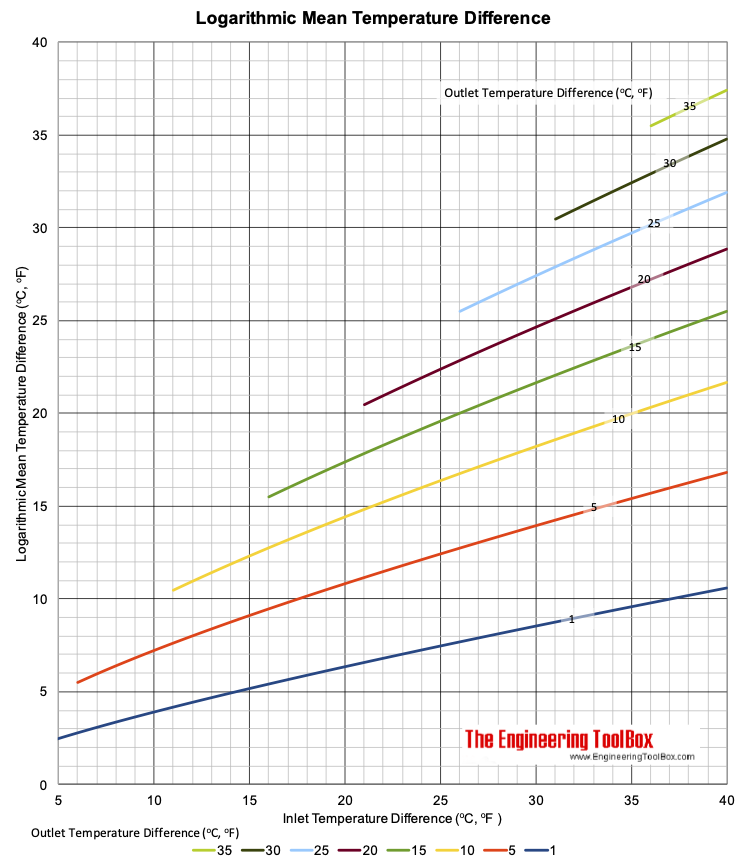
The chart expresses LMTD as a fraction of the larger terminal temperature difference. The ratio on the x-axis is Delta T min / Delta T max; the y-axis multiplier is applied to Delta T max.
LMTD factor vs. terminal temperature-difference ratio
Example - Hot Water Heating Air
Hot water at 80 degC heats air from 0 degC to 20 degC in a parallel-flow heat exchanger. The water leaves the heat exchanger at 60 degC.
Arithmetic mean temperature difference:
Logarithmic mean temperature difference:
Example - Steam Heating Water
Steam at 2 bar gauge heats water from 20 degC to 50 degC. The saturation temperature of steam at 2 bar gauge is 134 degC, so the steam-side temperature is treated as constant while steam condenses.
Arithmetic mean temperature difference:
Logarithmic mean temperature difference:
Restored Original Source Tables
The following tables are restored from the original source page to preserve the complete reference data. The cached source tables for this page are shared search/layout artifacts with no heat-exchanger engineering rows; substantive source chart data and examples are represented in the calculator, InteractiveChart, and examples above.
Cell 1 | Cell 2 | Cell 3 | Cell 4 | Cell 5 |
|---|---|---|---|---|
| × | × | 検索 | ||
| × |
Source: engineeringtoolbox.com
Original Source Images
The following original source images are preserved to avoid losing visual reference material. When an image contains chart or tabular data, its extracted values are represented in the page tables, calculators, or interactive charts; remaining images are retained as visual source references.
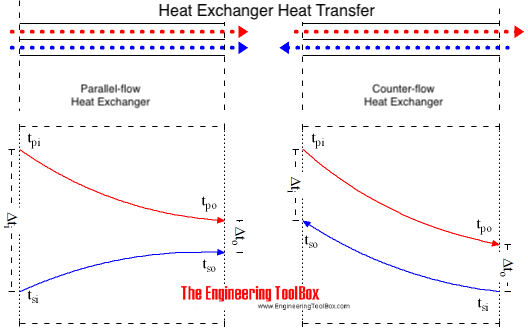 Logarithmic mean temperature difference
Engineering Notes
- The LMTD method assumes a constant overall heat transfer coefficient (U), which may not hold if fluid properties change significantly with temperature.
- It is directly applicable to simple flow arrangements like pure counter-flow or parallel-flow. For shell-and-tube or cross-flow exchangers, correction factors are typically required.
- Ensure (\Delta T_1) and (\Delta T_2) are positive and not equal to avoid logarithmic errors. If they are equal, the LMTD simplifies to their common value.
- For design-critical applications, validate results with manufacturer data or more advanced simulation methods, as real-world effects like fouling and flow maldistribution are not captured.
- Input temperatures should be within practical ranges; extreme differences may necessitate checking material limits or additional safety margins.