
Convective Heat Transfer Coefficients
Natural and forced convection heat transfer coefficients for common situations.
Overview
Convective heat transfer is the process of heat exchange between a solid surface and a moving fluid (liquid or gas). The rate of this transfer is governed by Newton's Law of Cooling and is influenced by the fluid's properties, flow regime (laminar or turbulent), surface geometry, and flow velocity.
Key Formulas
Newton's Law of Cooling calculates the total heat transfer rate.
Convective Heat Transfer Calculator
The convection coefficient (h) is often determined from empirical correlations involving dimensionless numbers like the Nusselt (Nu), Reynolds (Re), and Prandtl (Pr) numbers. A common form for forced convection over a flat plate is:
Where h = (Nu * k) / L, with k being the fluid's thermal conductivity and L a characteristic length.
Variables
Symbol | Variable | SI Unit | Description |
|---|---|---|---|
| Q | Heat Transfer Rate | W | Total energy transferred per unit time |
| h | Convection Coefficient | W/(m²·K) | Proportionality constant; depends on flow and fluid properties |
| A | Surface Area | m² | Area of the surface in contact with the fluid |
| ΔT | Temperature Difference | K | Difference between surface and bulk fluid temperature |
| Nu | Nusselt Number | - | Dimensionless; ratio of convective to conductive heat transfer |
| Re | Reynolds Number | - | Dimensionless; ratio of inertial to viscous forces |
| Pr | Prandtl Number | - | Dimensionless; ratio of momentum diffusivity to thermal diffusivity |
| k | Thermal Conductivity | W/(m·K) | Property of the fluid |
Source: engineeringtoolbox.com
Typical Convection Coefficients
The value of h varies enormously. Use these as rough order-of-magnitude estimates for initial design.
Convection Process | h (W/m²·K) | Typical Context |
|---|---|---|
| Free Convection, Air | 5 - 25 | Vertical plate, heated. Minimal fan effect. |
| Forced Convection, Air | 10 - 200 | Airflow over surfaces, electronics cooling. |
| Forced Convection, Oil | 60 - 1800 | Hydraulic systems, engine lubrication. |
| Forced Convection, Water | 300 - 6000 | Pipe flow, heat exchangers. |
| Boiling Water | 3000 - 100000 | High values due to phase change (latent heat). |
| Condensing Steam | 5000 - 100000 | Similar high values from latent heat release. |
Source: engineeringtoolbox.com
Forced and Natural Convection
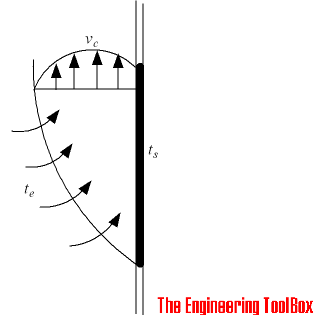
Forced convection occurs when a fluid flow is induced by an external force, such as a pump, fan or mixer. Natural or free convection is caused by buoyancy forces due to density differences caused by temperature variations in the fluid. Heat transfer per unit surface through convection was first described by Newton and the relation is known as Newton's Law of Cooling.
Example - Convective Heat Transfer
For an outside wall with surface area 60 m2, a convection coefficient of 8 W/(m2 K), and a 12 K temperature difference between the wall surface and the surrounding air:
The heat transfer rate is therefore 5.76 kW from the warmer surface to the cooler air. The same relationship applies to cooling coils, heated plates, process vessels, and pipe surfaces when a representative convection coefficient is known.
Unit Converter
Heat Transfer Unit Converter
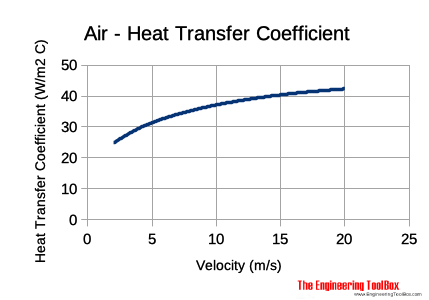
Air Flow Heat Transfer Coefficient Chart
For air flow, the source page gives the empirical approximation:
where is the relative speed between the object surface and air in m/s. The equation is empirical and applies approximately for velocities from 2 to 20 m/s.
Air Heat Transfer Coefficient vs Relative Velocity
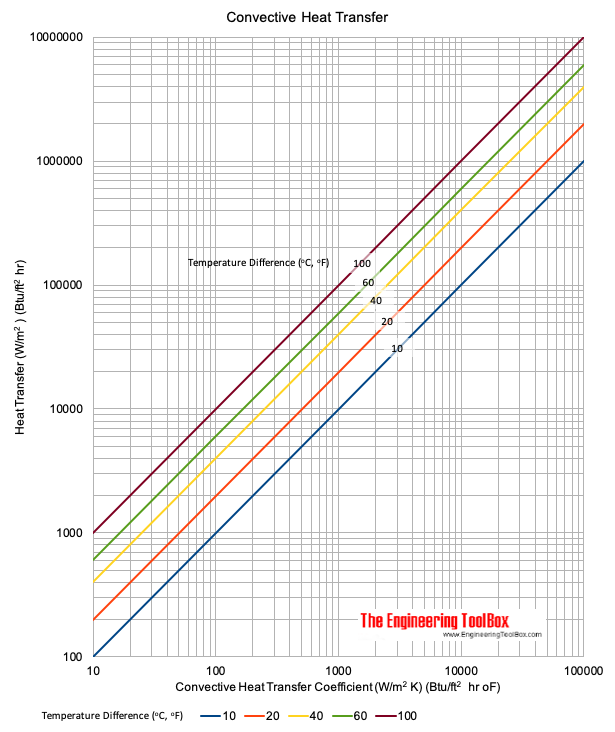
Convective Heat Transfer Coefficient Chart
The original convective_heat_transfer_chart.png image is represented below as interactive data. Because the source graphic is a range chart, each process is plotted with lower and upper coefficient bounds.
Typical Convection Coefficient Ranges
Restored Original Source Tables
The following tables are restored from the original source page to preserve the complete reference data. The cached source page contains shared search/layout tables with no engineering rows; the substantive convection data is preserved in the coefficient DataTables and InteractiveChart above.
Original Source Images
The following original source images are preserved to avoid losing visual reference material. When an image contains chart or tabular data, its extracted values are represented in the page tables, calculators, or interactive charts; remaining images are retained as visual source references.
Engineering Notes
- Newton's Law of Cooling is a definition, not a predictive law. The complex part of any analysis is determining the appropriate value of
h. - Flow regime is critical. Turbulent flow generally yields much higher
hvalues than laminar flow. - Fluid properties (density, viscosity, specific heat, conductivity) are temperature-dependent. Correlations often use properties evaluated at the film temperature, the average of the surface and free-stream temperatures.
- Surface roughness, orientation, and boundary layer development significantly impact performance.
- Phase change (boiling, condensation) dramatically increases heat transfer coefficients and requires specialized correlations.