
NPSH and Pump Cavitation
Net positive suction head calculation, cavitation prevention, and pump suction design.
Overview
Net Positive Suction Head (NPSH) determines whether a pump can operate without cavitation — the formation and collapse of vapor bubbles that damages impellers and degrades performance. Every centrifugal pump has an NPSH required (NPSHr) curve supplied by the manufacturer. The system must provide NPSH available (NPSHa) that exceeds NPSHr with an adequate margin at all operating points.
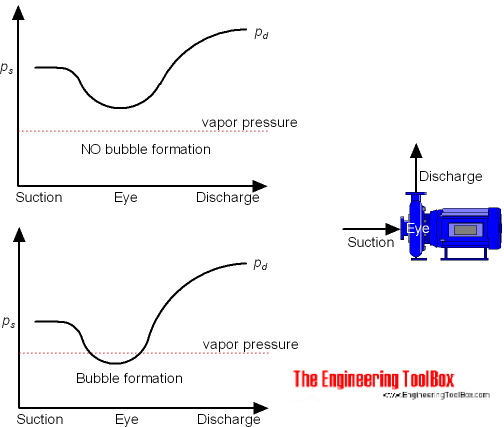
Cavitation occurs when the local static pressure at the pump inlet drops below the liquid's vapor pressure. Flashing vapor disrupts flow, creates noise, and erodes metal surfaces. Proper suction piping design and elevated source tanks are the primary tools for preventing it.
Key Formulas
NPSH available (absolute-head form):
NPSH margin ratio (dimensionless safety check):
Vapor-pressure head:
Variables
| Symbol | Description | Typical Unit |
|---|---|---|
| Absolute pressure at pump suction | Pa | |
| Vapor pressure of liquid at pumping temperature | Pa | |
| Liquid density | kg/m³ | |
| Gravitational acceleration (9.81) | m/s² | |
| Static suction head (+) or suction lift (−) | m | |
| Friction head loss in suction piping | m | |
| NPSHr | Required NPSH (from pump curve) | m |
Vapor Pressure of Water
Accurate values are essential for NPSHa calculations. Water vapor pressure rises steeply with temperature:
Temperature(°C) | Vapor Pressure(kPa abs) |
|---|---|
| 10 | 1.23 |
| 20 | 2.34 |
| 30 | 4.25 |
| 40 | 7.38 |
| 50 | 12.35 |
| 60 | 19.94 |
| 70 | 31.19 |
| 80 | 47.39 |
| 90 | 70.14 |
| 100 | 101.33 |
Source: engineeringtoolbox.com
Water Vapor Pressure vs Temperature
Typical NPSH Margin Guidelines
Service Type | Min NPSHa / NPSHr |
|---|---|
| General water service | 1.1 |
| Hot water / condensate | 1.3 |
| Hydrocarbons near boiling | 1.5 |
| Boiler feed water | 2 |
| Low-suction-head lift applications | 1.5 |
| Variable-speed / wide operating range | 1.5 |
Source: engineeringtoolbox.com
Calculator — NPSHa Estimate
NPSH Available
NPSH Margin and Unit Converter
Source Concepts Preserved
The source page distinguishes suction head, liquid vapor head, net positive suction head, available NPSH, and required NPSH. For an open suction tank, atmospheric pressure contributes positive pressure head, vapor pressure subtracts vapor head, static liquid level adds or subtracts elevation head, and suction-pipe friction subtracts loss. Liquids with dissolved gas can cavitate or release gas before reaching the pure-liquid vapor-pressure limit, so hot water, hydrocarbons and gas-rich liquids need additional margin.
Example - Pumping Water from an Open Tank
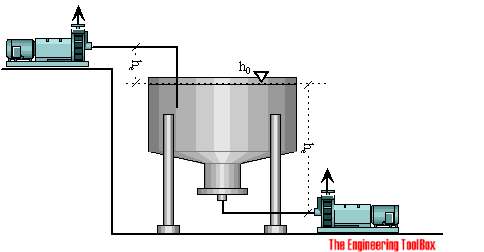
For a pump taking water from an open tank at sea level, atmospheric pressure supplies about 10.3 m of water head. The available NPSH is reduced by the liquid vapor-pressure head, suction lift or increased by flooded suction head, and suction-pipe friction losses.
As an example, water at 20 °C has vapor pressure about 2.3 kPa, corresponding to approximately 0.24 m water vapor head. With an open tank, pump centerline 3 m below the water surface, and 0.5 m suction friction loss:
If the same pump were installed with 3 m suction lift instead of flooded suction, the elevation term would be negative and the available NPSH would drop to roughly 6.56 m.
NPSH and Liquids with Dissolved Gas
Liquids that contain dissolved air or other gases may release gas when pressure falls, even before the pure-liquid vapor pressure is reached. This gas release can reduce pump performance, cause noisy operation, and mimic cavitation symptoms. Hot water, condensate, hydrocarbons, and process liquids close to their boiling point should therefore be designed with extra NPSH margin and conservative suction piping.
Degassing, subcooling the liquid, increasing tank elevation, pressurizing the suction vessel, lowering suction-line velocity, and reducing fittings in the suction run are common ways to improve NPSHa for gas-rich liquids.
Restored Original Source Tables
The following tables are restored from the original source page to preserve the complete reference data.
Suction Head and Reduction in Suction Lift for Water and Temperature
oC(oC) | kN/m2, kPa(kN/m2, kPa) | m(m) | m(m) |
|---|---|---|---|
| 0 | 0.6 | 0 | 10.3 |
| 5 | 0.9 | 0 | 10.2 |
| 10 | 1.2 | 0 | 10.2 |
| 15 | 1.7 | 0 | 10.2 |
| 20 | 2.3 | 0.1 | 10.1 |
| 25 | 3.2 | 0.2 | 10 |
| 30 | 4.3 | 0.3 | 9.9 |
| 35 | 5.6 | 0.4 | 9.8 |
| 40 | 7.7 | 0.7 | 9.5 |
| 45 | 9.6 | 0.8 | 9.4 |
| 50 | 12.5 | 1.1 | 9.1 |
| 55 | 15.7 | 1.5 | 8.7 |
| 60 | 20 | 1.9 | 8.3 |
| 65 | 25 | 2.3 | 7.8 |
| 70 | 32.1 | 3.1 | 7.1 |
| 75 | 38.6 | 3.8 | 6.4 |
| 80 | 47.5 | 4.7 | 5.5 |
| 85 | 57.8 | 5.8 | 4.4 |
| 90 | 70 | 7 | 3.2 |
| 95 | 84.5 | 8.5 | 1.7 |
| 100 | 101.33 | 10.2 | 0 |
Source: engineeringtoolbox.com
Reduction in Suction Lift for Water vs. Altitude
Altitude(m) | Reduction in Suction Lift (m) |
|---|---|
| 0 | 0 |
| 250 | 0.3 |
| 500 | 0.6 |
| 750 | 0.89 |
| 1000 | 1.16 |
| 1250 | 1.44 |
| 1500 | 1.71 |
| 1750 | 1.97 |
| 2000 | 2.22 |
| 2250 | 2.47 |
| 2500 | 2.71 |
Source: engineeringtoolbox.com
Suction Heads Pumping Hydrocarbons
Fluid | Temperature(oC) | abs Vapor Pressure (kPa) |
|---|---|---|
| Ethanol | 20 | 5.9 |
| 65 | 58.2 | |
| Methyl Acetate | 20 | 22.8 |
| 55 | 93.9 |
Source: engineeringtoolbox.com
Original Source Images
The following original source images are preserved to avoid losing visual reference material. When an image contains chart or tabular data, its extracted values are represented in the page tables, calculators, or interactive charts; remaining images are retained as visual source references.

Pump System Curve - Interactive Representation
Pump System Curve and Best Efficiency Region
Engineering Notes
- Always use absolute pressures. A common mistake is mixing gauge and absolute values. Atmospheric ≈ 101.3 kPa abs at sea level.
- Hot liquids are the biggest risk. Vapor pressure of water at 80 °C is ~47 kPa — almost half atmospheric — leaving very little NPSHa margin in open systems.
- Include acceleration head for reciprocating (positive-displacement) pumps; the pulsating flow adds an extra suction-side pressure drop not captured by steady-state friction.
- Pipe sizing matters. Undersized suction piping increases velocity head and friction loss, both of which reduce NPSHa.
- Elevation of source relative to pump () is measured from liquid surface to pump centerline; a flooded arrangement (+) is far more reliable than suction lift (−).
- Viscous or high-specific-gravity fluids increase friction loss and may shift the NPSHr curve; consult the pump manufacturer for correction factors.
- Submergence requirements at the suction intake prevent vortexing and air entrainment, which effectively reduce NPSHa even when the static level looks adequate.