
Pressure Loss Copper Pipes
Reference data and engineering information about pressure loss copper pipes for fluid mechanics applications.
Overview
Engineering ToolBox - Resources, Tools and Basic Information for Engineering and Design of Technical Applications!
Pressure loss in copper water tubes is a primary consideration in plumbing system design. This reference covers seamless copper tubes manufactured to ASTM B88 in Types K, L, and M, which differ by wall thickness and service rating. Type K has the thickest walls and is rated for high-pressure and underground applications; Type L is the standard choice for most domestic water distribution; Type M has the thinnest walls and is limited to residential and low-pressure service.
Friction (major) losses in these tubes are commonly estimated using the Hazen-Williams equation with a roughness coefficient of C = 145, reflecting the smooth interior surface of new copper.
Key Formulas
Hazen-Williams Pressure Loss (Imperial)
This gives the friction pressure loss per 100 ft of straight pipe in psi, where Q is in gpm and D is the internal diameter in inches.
Flow Velocity from Flow Rate
Velocity is critical for erosion control and noise prevention in copper piping.
Variables
| Symbol | Description | Unit |
|---|---|---|
| ΔP | Pressure loss per 100 ft | psi |
| Q | Volumetric flow rate | gpm |
| C | Hazen-Williams roughness coefficient | — |
| D | Inside diameter | in |
| v | Flow velocity | ft/s |
| A | Cross-sectional area | in² |
Calculator: Flow Velocity
Flow Velocity in a Copper Tube
Unit Converter
The original source included a Unit Converter section. This migrated converter keeps pressure loss, water flow, tube size, and velocity units together for copper-tube sizing.
Copper Tube Pressure Loss Unit Converter
Copper Tube Dimensions — ASTM B88
Nominal Size | Outside Diameter(in) | Type K ID(in) | Type L ID(in) | Type M ID(in) |
|---|---|---|---|---|
| 3/8 | 0.5 | 0.402 | 0.43 | 0.45 |
| 1/2 | 0.625 | 0.527 | 0.545 | 0.569 |
| 3/4 | 0.875 | 0.745 | 0.785 | 0.811 |
| 1 | 1.125 | 0.995 | 1.025 | 1.055 |
| 1-1/4 | 1.375 | 1.245 | 1.265 | 1.291 |
| 1-1/2 | 1.625 | 1.481 | 1.505 | 1.541 |
| 2 | 2.125 | 1.959 | 2.009 | 2.049 |
| 2-1/2 | 2.625 | 2.435 | 2.495 | 2.527 |
| 3 | 3.125 | 2.907 | 2.981 | 3.017 |
| 4 | 4.125 | 3.859 | 3.933 | 3.981 |
Source: ASTM B88
Pressure Loss Reference — Type L Copper (psi per 100 ft)
Flow Rate(gpm) | 1/2" (ID 0.545 in)(psi/100ft) | 3/4" (ID 0.785 in)(psi/100ft) | 1" (ID 1.025 in)(psi/100ft) | 1-1/4" (ID 1.265 in)(psi/100ft) | 1-1/2" (ID 1.505 in)(psi/100ft) | 2" (ID 2.009 in)(psi/100ft) |
|---|---|---|---|---|---|---|
| 1 | 3 | 0.7 | 0.2 | — | — | — |
| 2 | 10.1 | 2.4 | 0.8 | 0.3 | — | — |
| 3 | 20.7 | 5 | 1.5 | 0.6 | 0.3 | — |
| 4 | 34.3 | 8.4 | 2.6 | 1 | 0.5 | — |
| 5 | 51 | 12.6 | 3.8 | 1.5 | 0.8 | 0.2 |
| 8 | — | 29.3 | 8.9 | 3.5 | 1.8 | 0.5 |
| 10 | — | 44 | 13.4 | 5.3 | 2.7 | 0.8 |
| 15 | — | — | 27.8 | 11 | 5.6 | 1.6 |
| 20 | — | — | 46.5 | 18.4 | 9.3 | 2.7 |
| 25 | — | — | — | 27.6 | 14 | 4.1 |
| 30 | — | — | — | 38.6 | 19.5 | 5.7 |
Source: engineeringtoolbox.com
Pressure Loss Reference — Types K, L and M
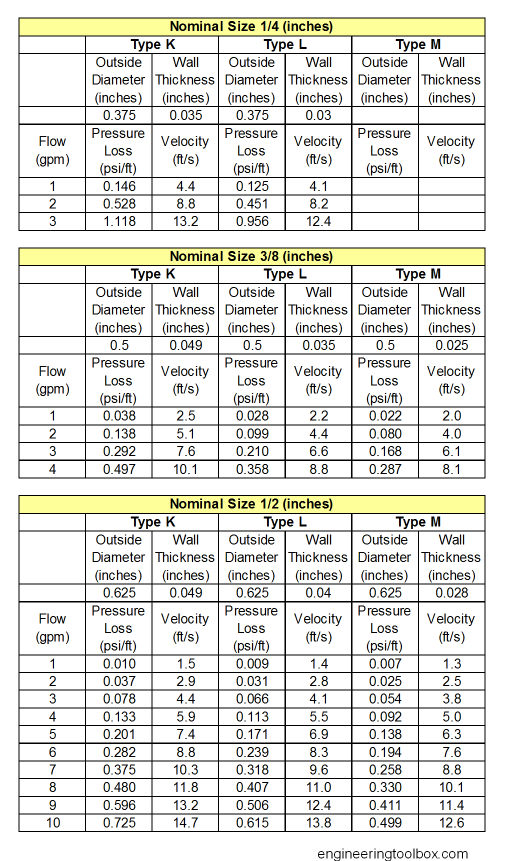
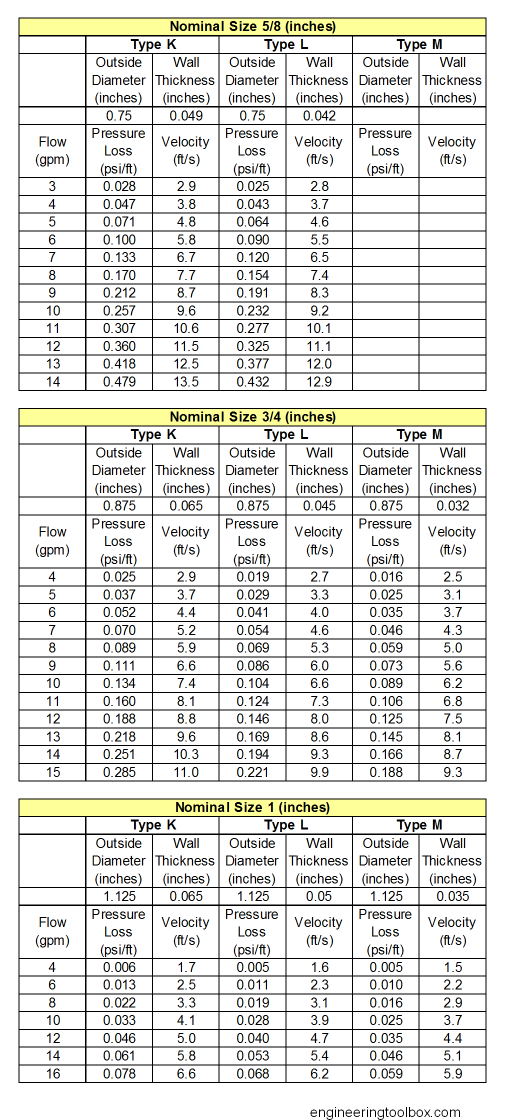
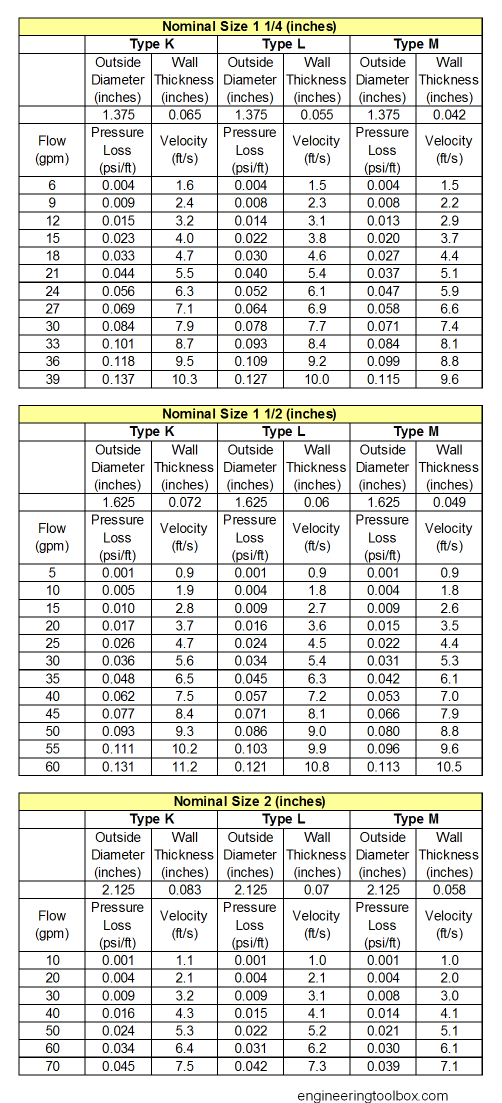
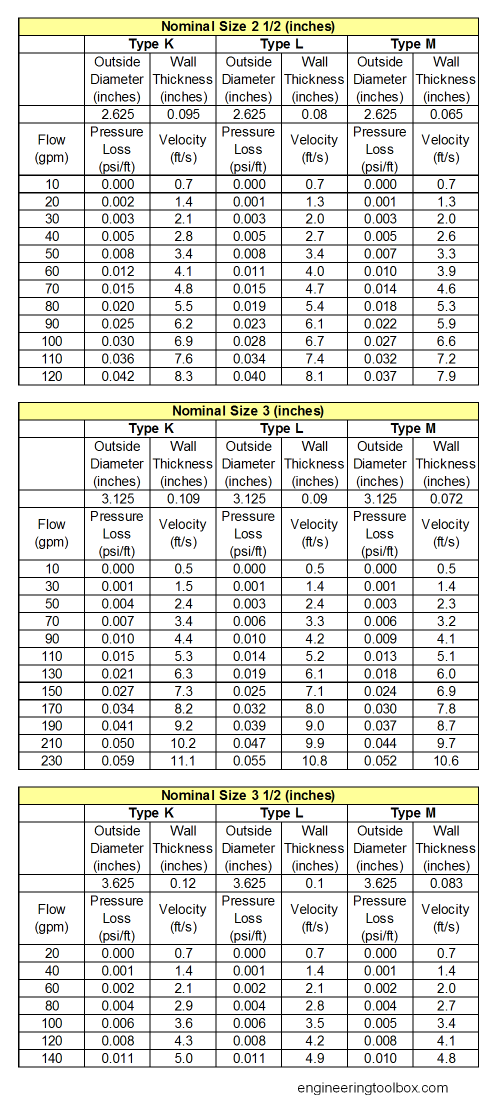
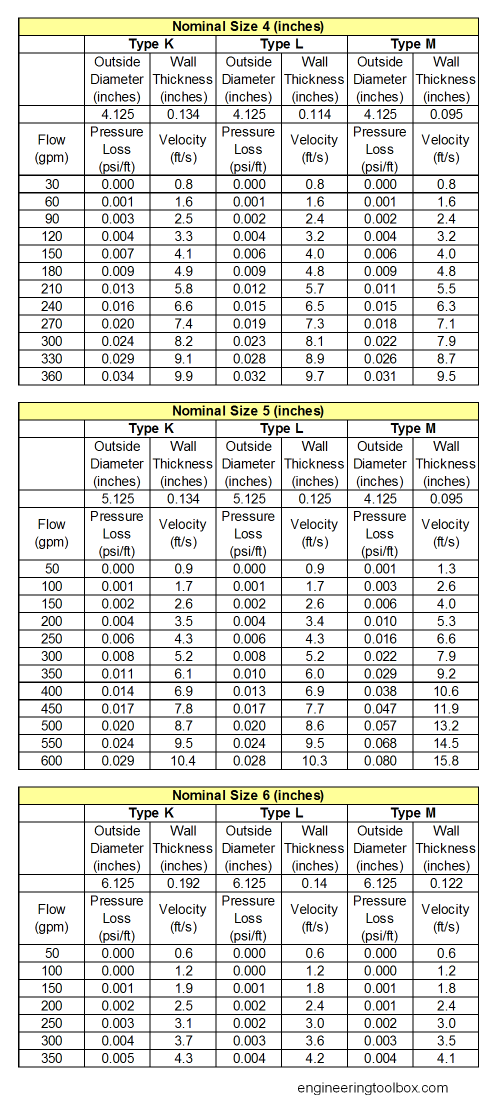
The original source preserves pressure-loss data for copper tube Types K, L, and M as image tables. The interactive table below represents the same comparison using the Hazen-Williams relation with C = 145 and the ASTM B88 inside diameters listed above. Type K has the smallest ID and therefore the highest pressure loss; Type M has the largest ID and the lowest pressure loss for the same nominal size and flow.
Nominal size | Flow(gpm) | Type K(psi/100 ft) | Type L(psi/100 ft) | Type M(psi/100 ft) |
|---|---|---|---|---|
| 1/2 | 1 | 3.57 | 3.04 | 2.45 |
| 1/2 | 2 | 12.86 | 10.95 | 8.84 |
| 1/2 | 3 | 27.2 | 23.17 | 18.7 |
| 3/4 | 3 | 6.35 | 4.91 | 4.19 |
| 3/4 | 5 | 16.32 | 12.61 | 10.77 |
| 3/4 | 8 | 39.04 | 30.18 | 25.79 |
| 1 | 5 | 4.41 | 3.81 | 3.32 |
| 1 | 10 | 15.88 | 13.72 | 11.94 |
| 1 | 20 | 57.2 | 49.41 | 43 |
| 1-1/2 | 20 | 10.08 | 9.31 | 8.29 |
| 1-1/2 | 30 | 21.32 | 19.69 | 17.54 |
| 2 | 30 | 6.5 | 5.74 | 5.21 |
| 2 | 50 | 16.72 | 14.77 | 13.4 |
| 3 | 100 | 8.2 | 7.25 | 6.84 |
| 4 | 200 | 6.55 | 5.97 | 5.62 |
Source: engineeringtoolbox.com
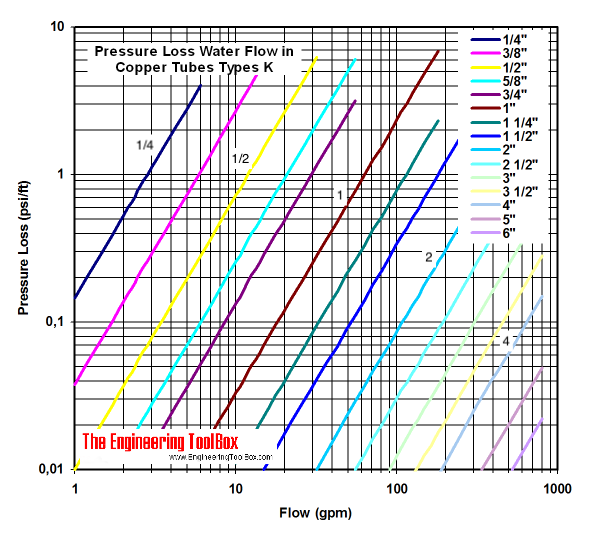
Copper Tube Type K, L and M Pressure Loss
Pressure Loss Reference — Type L Copper — Velocity Comparison
Friction Loss vs. Flow Rate for Type L Copper
Velocity Guidelines
Limiting water velocity protects against erosion-corrosion, reduces noise, and extends tube service life.
| Service | Maximum Velocity |
|---|---|
| Cold water | 8 ft/s (2.4 m/s) |
| Hot water up to 140°F (60°C) | 5 ft/s (1.5 m/s) |
| Hot water above 140°F (60°C) | 2–3 ft/s (0.6–0.9 m/s) |
Exceeding these limits accelerates pitting in copper, especially at elevated temperatures where dissolved oxygen aggressiveness increases.
Fittings and Valves
The original source notes that pressure loss in copper tube fittings and valves can be expressed as equivalent length of tube. In practical sizing, add the equivalent length for elbows, tees, reducers, valves, strainers, and meters to the measured straight-pipe length before applying the pressure-loss tables or calculator.
Download the diagram as pdf-file: Pressure Loss in Copper Tubes ASTM B88 - Type K.
Download and print the source diagram: Pressure Loss in Copper Tubes ASTM B88 - Type K. Also cross-check the companion source reference Copper Tubes - Pressure Loss in Fittings and Valves Expressed as Equivalent Length of Tube when a system includes many fittings.
Restored Original Source Tables
The following tables are restored from the original source page to preserve the complete reference data.
Original Source Images
The following original source images are preserved to avoid losing visual reference material. When an image contains chart or tabular data, its extracted values are represented in the page tables, calculators, or interactive charts; remaining images are retained as visual source references.
Engineering Notes
- Hazen-Williams limitations. The equation is an empirical correlation valid for water at normal ambient temperatures and turbulent flow. It is not suitable for viscous fluids, gases, or extreme temperatures outside the typical domestic plumbing range.
- Roughness coefficient C = 145 applies to new, clean copper. Over time, mineral scale or dezincification in aggressive water can reduce C, increasing losses. Some designers use C = 130–140 as a conservative long-term value.
- Fittings and valves add significant minor losses. The equivalent-length method is standard: each fitting is assigned an equivalent length of straight pipe. Typical values range from 0.5 ft for a 90° elbow to 10+ ft for a gate valve, depending on size.
- Type selection matters. Types K, L, and M have different IDs for the same nominal size. Type L has about 3% more ID than Type K; Type M has about 5% more than Type K. These differences shift pressure loss values by several percent at the same flow rate.
- Altitude and temperature corrections. Water density and viscosity change with temperature and elevation. For precise work above 5,000 ft or at temperatures significantly different from 60°F, apply correction factors to the base Hazen-Williams result.
References
- Original Source — Engineering ToolBox: Pressure Loss in Copper Pipes
- ASTM B88 — Seamless Copper Water Tubes
- Hazen-Williams equation with C = 145 for copper tubing