
Pump Power Calculator
Pump power calculation for water and other fluids including head, flow rate, and efficiency.
Overview
Pump power calculations determine the energy required to move fluid through a system. The three key power levels are hydraulic power (useful work on the fluid), shaft power (power delivered to the pump), and motor power (electrical input). Understanding these relationships is essential for pump selection, energy cost estimation, and system design.
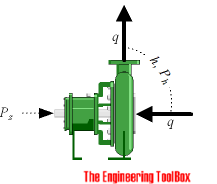
Original source text preserved: "The ideal hydraulic power to drive a pump depends on the mass flow rate the liquid density the differential height - either it is the static lift from one height to an other or the total head loss component of the system - and can be calculated like Ph(kW) = q ρ g h / 3.6×106 = q p / 3.6×10⁶." The source also states: "The shaft power - the power required transferred from the motor to the shaft of the pump - depends on the efficiency of the pump."
Key Formulas
The hydraulic power delivered to the fluid is:
Accounting for pump efficiency, the required shaft power is:
Accounting for motor efficiency, the electrical input power is:
Combining into a single expression:
Hydraulic Horsepower - Imperial Units
The original source formula is preserved explicitly:
where q_gpm is flow in US gallons per minute, h_ft is head in feet, SG is specific gravity, and efficiency is pump efficiency as a decimal. If efficiency is omitted, q_gpm h_ft SG / 3960 gives water horsepower.
Variables
| Symbol | Description | Unit |
|---|---|---|
| Hydraulic power (useful work on fluid) | kW | |
| Shaft power at pump coupling | kW | |
| Electrical motor input power | kW | |
| Fluid density | kg/m³ | |
| Gravitational acceleration (9.81) | m/s² | |
| Volumetric flow rate | m³/s | |
| Total dynamic head | m | |
| Pump efficiency (decimal) | — | |
| Motor efficiency (decimal) | — |
Pump Power Calculator
Pump Power Calculator - Imperial Units
Unit Converter
Pump Power Unit Converter
Example Calculations
SI Units
For water at 1000 kg/m³, flow rate 50 m³/h, total head 30 m, pump efficiency 75%, and motor efficiency 90%:
Imperial Units
For water at SG = 1.0, flow rate 500 US gpm, total head 100 ft, pump efficiency 70%, and motor efficiency 90%:
The imperial hydraulic horsepower formula from the source is:
where q_gpm is flow in US gallons per minute, h_ft is head in feet, SG is specific gravity, and efficiency is pump efficiency as a decimal. Without the efficiency term, q_gpm h_ft SG / 3960 is water horsepower.
Pump Shaft Power Charts
The original page includes metric and imperial shaft-power diagrams. The interactive chart below represents the same relationship for water at 70% pump efficiency.
Pump Shaft Power vs Flow and Head
Pump Power Formula Chart
The source pump_power.png image summarizes equivalent SI and Imperial pump power forms. This interactive representation compares hydraulic, shaft, and motor input power for the same duty point.
Pump Hydraulic, Shaft and Motor Power
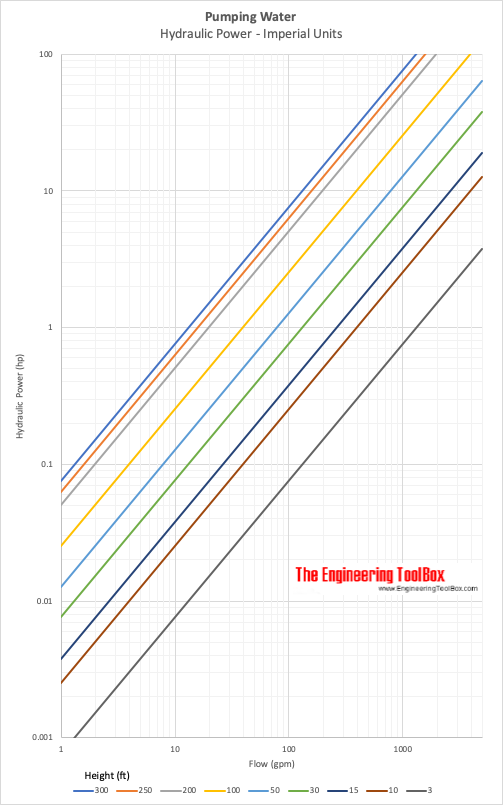
Pump Shaft Power Chart - Imperial Units
The original pump_shaft_power_imperial.png diagram is represented below using the water horsepower relationship at 70% pump efficiency.
Pump Shaft Power vs Flow and Head - Imperial Units
Related Mobile Apps from The Engineering ToolBox
The source page included a related mobile-app section. In this migration the SI and Imperial pump power calculators are directly available on the page as browser-based tools for mobile and desktop use.
Typical Pump Efficiencies
Pump Type | Flow Range(m³/h) | Typical Efficiency(%) |
|---|---|---|
| Small centrifugal | 1–20 | 40–60 |
| Medium centrifugal | 20–200 | 60–80 |
| Large centrifugal | 200–5000 | 75–90 |
| Submersible pump | 5–200 | 50–75 |
| Gear / rotary pump | 1–100 | 50–80 |
| Reciprocating piston | 0.5–100 | 70–90 |
| Axial flow (propeller) | 500–50000 | 80–90 |
Source: engineeringtoolbox.com
Specific Speed and Efficiency Relationship
Specific Speed (Ns)(—) | Impeller Type | Best Efficiency(%) |
|---|---|---|
| 500 | Radial, narrow | 72 |
| 1000 | Radial | 80 |
| 2000 | Radial, Francis vane | 85 |
| 4000 | Mixed flow | 87 |
| 7000 | Mixed flow | 86 |
| 10000 | Axial flow | 84 |
Source: engineeringtoolbox.com
Restored Original Source Tables
The following tables are restored from the original source page to preserve the complete reference data.
The cached source table outside the diagrams contains site layout and calculator shell rows rather than engineering data. It is intentionally consolidated into the SI and Imperial calculators, the unit converter, and the metric/imperial shaft-power interactive charts above.
Source row text | Migration handling |
|---|---|
| × | | × | 検索 | | Site close/search layout row from cached source; not pump engineering data. |
| | × | Site layout/control row from cached source; preserved here as source-table coverage. |
Source: engineeringtoolbox.com
Original Source Images
The following original source images are preserved to avoid losing visual reference material. When an image contains chart or tabular data, its extracted values are represented in the page tables, calculators, or interactive charts; remaining images are retained as visual source references.
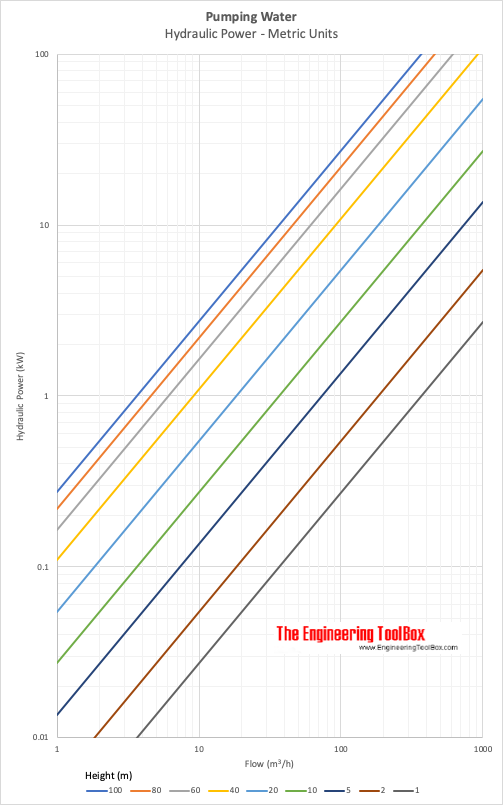 Pumps - shaft power vs. flow and lift diagram - Metric Units
Engineering Notes
- Unit consistency: Flow rate in m³/s is required in the SI formula. Convert from m³/h by dividing by 3600.
- Total dynamic head (H) includes static lift, friction losses, and any required discharge pressure converted to equivalent fluid column height.
- Efficiency varies with operating point: The listed efficiencies represent best efficiency point (BEP). Operating far from BEP significantly reduces actual efficiency.
- Specific gravity: For fluids other than water, use in place of water density. Alternatively, multiply water power by specific gravity (SG).
- VFD considerations: With variable frequency drives, motor efficiency may vary with speed. Refer to motor efficiency curves rather than a single nominal value.
- Viscous fluids: High-viscosity fluids reduce pump performance below catalog water-test values. Apply viscosity correction factors per HI (Hydraulic Institute) standards.
- Safety margins: It is common practice to select a motor rated 10–15% above calculated shaft power to handle transient overloads and future degradation.
References
- Original Source
- Hydraulic Institute, Engineering Data Book, pump application standards