
Sound Absorption Coefficients of Common Materials
Sound absorption coefficients (α) for building and acoustic materials at standard frequencies.
Overview
Sound absorption coefficients describe how much incident sound energy a material absorbs rather than reflects. Values range from 0 (total reflection) to 1 (total absorption) and vary with frequency. Engineers use these coefficients to predict reverberation time, select acoustic treatments, and design enclosures, partitions, and auditoriums.
The Noise Reduction Coefficient (NRC) is a single-number rating equal to the arithmetic average of the absorption coefficients at 250, 500, 1000, and 2000 Hz, rounded to the nearest 0.05.
Original source context preserved: mean absorption coefficients are used to describe the acoustic character of a room, and reverberation time increases as the mean absorption coefficient decreases. Very soft rooms, soft rooms, normal rooms, hard rooms, and very hard rooms can be compared by their reverberation time and mean sound absorption coefficient.
The table below indicates mean sound absorption coefficient - αm - and reverberation time - Ta - for some typical rooms.
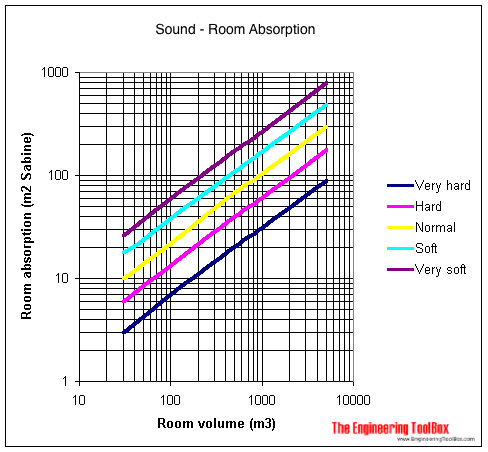
The diagram below can be used to determine the sound absorption in rooms of different sizes and with different accoustic characteristics.
Key Formulas
Sabine Reverberation Time
The Sabine equation estimates the time (seconds) for sound to decay by 60 dB in a room.
Total Room Absorption
Total absorption (m² Sabins) equals the sum of each surface area multiplied by its absorption coefficient.
Noise Reduction Coefficient
Average of the four standard speech-band coefficients.
Variables
| Symbol | Description | Unit |
|---|---|---|
| Reverberation time (60 dB decay) | s | |
| Room volume | m³ | |
| Total sound absorption | m² Sabins | |
| Absorption coefficient (0–1) | — | |
| Surface area | m² |
Material Absorption Coefficients
Absorption coefficients depend on frequency. The table below lists representative values for common building and acoustic materials.
Material | 125 Hz | 250 Hz | 500 Hz | 1 kHz | 2 kHz | 4 kHz | NRC |
|---|---|---|---|---|---|---|---|
| Brick, unglazed | 0.03 | 0.03 | 0.03 | 0.04 | 0.05 | 0.07 | 0.05 |
| Concrete block, painted | 0.1 | 0.05 | 0.06 | 0.07 | 0.09 | 0.08 | 0.05 |
| Glass, window | 0.18 | 0.06 | 0.04 | 0.03 | 0.02 | 0.02 | 0.05 |
| Gypsum board on studs | 0.29 | 0.1 | 0.05 | 0.04 | 0.07 | 0.09 | 0.05 |
| Plywood panel (6 mm) | 0.28 | 0.22 | 0.17 | 0.09 | 0.1 | 0.11 | 0.15 |
| Carpet on concrete | 0.02 | 0.06 | 0.14 | 0.37 | 0.6 | 0.65 | 0.3 |
| Carpet on foam underlay | 0.08 | 0.24 | 0.57 | 0.69 | 0.71 | 0.73 | 0.55 |
| Curtains, heavy draped | 0.07 | 0.31 | 0.49 | 0.75 | 0.7 | 0.6 | 0.55 |
| Acoustic ceiling tile (mineral fibre) | 0.69 | 0.86 | 0.95 | 0.98 | 0.98 | 0.98 | 0.95 |
| Fibreglass, 25 mm on wall | 0.06 | 0.2 | 0.65 | 0.9 | 0.95 | 0.98 | 0.65 |
| Fibreglass, 50 mm on wall | 0.18 | 0.54 | 0.91 | 0.98 | 0.99 | 1 | 0.85 |
| Foam, open-cell 50 mm | 0.14 | 0.3 | 0.65 | 0.9 | 0.96 | 0.99 | 0.7 |
| Audience (seated, per person) | 0.35 | 0.45 | 0.57 | 0.61 | 0.62 | 0.6 | 0.55 |
| Wood floor on joists | 0.15 | 0.11 | 0.1 | 0.07 | 0.06 | 0.07 | 0.1 |
| Water surface / ice | 0.01 | 0.01 | 0.01 | 0.02 | 0.02 | 0.03 | 0.01 |
Source: engineeringtoolbox.com
Calculator — Reverberation Time
Sabine Reverberation Time (T₆₀)
Unit Converter
Room Acoustics Unit Converter
Interactive Room Absorption Diagram
The original SoundRoomAbsorption.gif diagram is represented below as interactive data from the restored room-characteristics table.
Room Absorption Characteristics
Restored Original Source Tables
The following tables are restored from the original source page to preserve the complete reference data.
The cached source page includes a non-engineering layout/search table before the acoustic data tables. For strict source-table preservation, the detected UI/search rows are reproduced below; they are not sound-absorption coefficient data.
Cell 1 | Cell 2 | Cell 3 | Cell 4 | Cell 5 |
|---|---|---|---|---|
| × | × | 検索 | ||
| × |
Source: engineeringtoolbox.com
Sound - Room Absorption Characteristics
Room Characteristics | Very Soft | Soft | Normal | Hard | Very Hard |
|---|---|---|---|---|---|
| Reverberation time - Ta - | 0.2 < Ta < 0.25 | 0.4 < Ta < 0.5 | 0.9 < Ta < 1.1 | 1.8 < Ta < 2.2 | 2.5 < Ta < 4.5 |
| Typical Room | Radio and TV studio | Restaurant Theater Lecture hall | Office Library Flat | Hospital Church | Large church Factory |
| Mean sound absorption coefficient - αm - | 0.4 | 0.25 | 0.15 | 0.1 | 0.05 |
Source: engineeringtoolbox.com
Original Source Images
The following original source images are preserved to avoid losing visual reference material. When an image contains chart or tabular data, its extracted values are represented in the page tables, calculators, or interactive charts; remaining images are retained as visual source references.
Engineering Notes
- Porous absorbers (fibreglass, foam, acoustic tile) perform best at mid and high frequencies. Increasing thickness shifts effective absorption to lower frequencies — a 25 mm panel typically needs frequencies above ~1 kHz to reach α > 0.5, while 100 mm panels extend this down to ~250 Hz.
- Panel / membrane absorbers (plywood, gypsum) resonate at low frequencies and are useful for bass control below ~500 Hz. Performance depends on panel mass, cavity depth, and mounting.
- Air gaps behind porous absorbers increase low-frequency performance nearly as well as adding equivalent absorber thickness.
- Measurement standards: ASTM C423 measures absorption in a reverberation room (random-incidence). Sabine and NRC values from this standard are most common in architectural acoustics. ISO 354 is the international equivalent.
- Area dependence: Absorption coefficients are not strictly additive per unit area — edge diffraction and non-uniform coverage can increase effective absorption. Manufacturers sometimes publish data for specific mounting configurations (Type A–E per ASTM).
- Moisture and aging: Mineral fibre and open-cell foam can lose performance if exposed to humidity or dust. Closed-cell foams and thin films do not absorb sound effectively.
- Audience and seating: Occupied seats absorb significantly more than empty upholstered seats. Design for partial occupancy if variable.
References
- Original Source — Engineering ToolBox: Sound Absorption Coefficients
- ASTM C423 — Standard Test Method for Sound Absorption and Sound Absorption Coefficients by the Reverberation Room Method
- ISO 354 — Acoustics — Measurement of sound absorption in a reverberation room