
Speed of Sound in Air, Water and Other Media
Speed of sound in various media including air, water, steel and other materials at different temperatures.
Overview
The speed of sound is the rate at which a pressure disturbance propagates through a medium. It depends on the elastic properties and density of the material. In gases it rises with temperature; in liquids and solids the relationship is governed by bulk modulus. Understanding sound speed is critical for acoustics, ultrasonics, aerodynamics, and underwater communication systems.
Key Formulas
Speed of Sound in an Ideal Gas
where is the ratio of specific heats, is the specific gas constant, and is the absolute temperature in kelvin.
Speed of Sound in Liquids and Solids
where is the bulk modulus (or modulus of elasticity for solids) and is the mass density.
General Relationship
Frequency times wavelength equals the speed of propagation.
Variables
| Symbol | Description | Typical Unit |
|---|---|---|
| Speed of sound | m/s | |
| Specific heat ratio (1.4 for air) | — | |
| Specific gas constant | J/(kg·K) | |
| Absolute temperature | K | |
| Bulk modulus / elastic modulus | Pa | |
| Density | kg/m³ | |
| Frequency | Hz | |
| Wavelength | m |
Speed of Sound in Common Media
Medium | Temperature(°C) | Speed of Sound(m/s) |
|---|---|---|
| Air (dry, 1 atm) | 0 | 331 |
| Air (dry, 1 atm) | 20 | 343 |
| Air (dry, 1 atm) | 100 | 386 |
| Carbon dioxide | 0 | 259 |
| Helium | 0 | 1007 |
| Hydrogen | 0 | 1270 |
| Water (fresh) | 20 | 1481 |
| Water (sea) | 20 | 1522 |
| Ethanol | 20 | 1162 |
| Mercury | 20 | 1450 |
| Aluminum (longitudinal) | 20 | 6420 |
| Steel (longitudinal) | 20 | 5960 |
| Glass (borosilicate) | 20 | 5640 |
| Rubber (hard) | 20 | 1560 |
| Wood (soft, along grain) | 20 | 3800 |
Source: engineeringtoolbox.com
Temperature Effect on Speed in Air
Speed of Sound in Air vs Temperature
Speed of Sound in Water vs Temperature
Temperature(°C) | Fresh Water(m/s) | Sea Water(m/s) |
|---|---|---|
| 0 | 1402 | 1449 |
| 5 | 1426 | 1471 |
| 10 | 1447 | 1490 |
| 15 | 1466 | 1507 |
| 20 | 1481 | 1522 |
| 25 | 1497 | 1535 |
| 30 | 1509 | 1546 |
| 40 | 1529 | 1565 |
| 60 | 1551 | 1593 |
Source: engineeringtoolbox.com
Calculator — Speed in Dry Air
Speed of Sound in Dry Air
Wavelength from Frequency
Unit Converter
Sound Speed Unit Converter
Subsonic and Supersonic Speed
If the Mach number is below 1, the flow velocity is lower than the local speed of sound and the speed is subsonic. If the Mach number is 1, the speed is transonic. If the Mach number is above 1, the flow velocity is higher than the speed of sound and the speed is supersonic.
Restored Original Source Tables
The following tables are restored from the original source page to preserve the complete reference data.
Bulk of Modulus and Density some common Substances
Substance | Bulk Modulus Elasticity - K - (109 N/m2) | Density - ρ - (kg/m3) |
|---|---|---|
| Water (10 oC) | 2.09 | 999.7 |
| Oil | 1.35 | 920 |
| Ethyl Alcohol | 1.06 | 810 |
| Mercury | 28.5 | 13595 |
Source: engineeringtoolbox.com
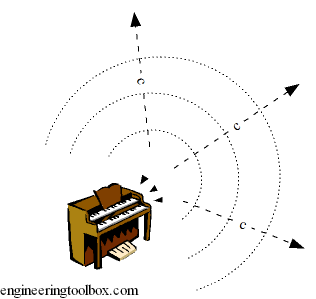
Original Source Images
The following original source image is preserved to avoid losing visual reference material.
Engineering Notes
- Temperature dominance in air. A rough rule of thumb: sound speed increases approximately 0.6 m/s for every 1 °C rise in temperature. Humidity has a minor secondary effect (~0.1–0.5 % variation).
- Pressure has negligible direct effect on sound speed in ideal gases because both density and bulk modulus scale proportionally with pressure, cancelling out. The dominant variable is temperature.
- In water, salinity, temperature, and pressure (depth) all measurably affect sound speed. Underwater acoustic models such as UNESCO's Chen-Millero equation account for all three variables.
- In solids, the type of wave matters. Longitudinal (P-wave) speeds shown above are higher than shear (S-wave) speeds. Surface (Rayleigh) and plate (Lamb) waves travel at still different rates.
- Sonic boom and Mach number. The local speed of sound defines the critical velocity for compressible flow. An object moving at Mach 1.0 creates a shock wave whose geometry depends directly on the ambient sound speed.
- Medical ultrasonics. Soft-tissue imaging assumes an average speed of 1540 m/s. Errors in assumed speed cause blurring and misregistration in ultrasound images.
- Mach cone angle is given by , where Ma is the Mach number. At higher altitudes, lower temperature reduces the speed of sound and widens the cone for the same airspeed.
References
- Engineering Toolbox — Speed of Sound
- Kinsler, L. E., et al., Fundamentals of Acoustics, 4th ed., Wiley.
- UNESCO, Algorithms for Fundamental Properties of Sea Water, Technical Papers in Marine Science.