
Young's Modulus of Elasticity
Elastic modulus values for common engineering materials.
Overview
Young's modulus () quantifies a material's stiffness in the elastic regime — the ratio of tensile stress to tensile strain. A higher means the material deforms less under load. Typical structural metals range from 70–215 GPa, while polymers can be orders of magnitude lower.
Young's modulus applies only within the proportional (elastic) limit of the stress–strain curve. Beyond yield, the relationship becomes nonlinear and permanent deformation begins.
Key Formulas
Hooke's Law (uniaxial stress–strain):
Axial elongation or compression:
Stress from force and area:
Strain from change in length:
Variables
| Symbol | Meaning | Typical Units |
|---|---|---|
| Young's modulus (modulus of elasticity) | GPa, psi | |
| Normal (tensile/compressive) stress | MPa, psi | |
| Engineering strain (dimensionless) | — | |
| Applied axial force | N, lbf | |
| Cross-sectional area | mm², in² | |
| Original length | m, in | |
| Change in length (elongation) | m, in |
Room-Temperature Values
Material | Young's Modulus(GPa) | Density(kg/m³) |
|---|---|---|
| Aluminum alloys | 69 | 2700 |
| Brass | 100 | 8500 |
| Bronze | 110 | 8800 |
| Cast iron (gray) | 92 | 7200 |
| Copper | 120 | 8900 |
| Carbon steel | 200 | 7850 |
| Stainless steel (304/316) | 193 | 8000 |
| Titanium (Ti-6Al-4V) | 116 | 4500 |
| Nickel | 200 | 8900 |
| Magnesium alloys | 45 | 1740 |
| Tungsten | 411 | 19300 |
| Lead | 14 | 11340 |
| Glass (soda-lime) | 70 | 2500 |
| Concrete | 30 | 2400 |
| Nylon | 3 | 1150 |
| HDPE | 1 | 960 |
Source: engineeringtoolbox.com
Temperature Effects on Steel (ASME B31.1)
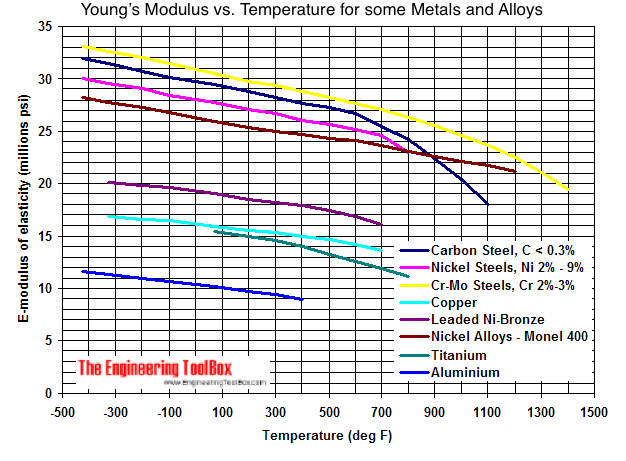
Young's modulus decreases with rising temperature. The following data, derived from ASME B31.1-1995, show this trend for common piping and structural steels. All values converted from 10⁶ psi to GPa (1 × 10⁶ psi = 6.895 GPa).
For full table with higher temperatures, rotate narrow screens horizontally. You can use the pressure unit converter below to switch between units of modulus of elasticity.
Young's Modulus vs Temperature — Steels
Steel type | −73 °C(GPa) | 21 °C(GPa) | 93 °C(GPa) | 149 °C(GPa) | 204 °C(GPa) | 260 °C(GPa) |
|---|---|---|---|---|---|---|
| Carbon steel (C ≤ 0.3%) | 208 | 203 | 199 | 195 | 191 | 187 |
| Carbon steel (C ≥ 0.3%) | 207 | 202 | 197 | 194 | 190 | 186 |
| Carbon-Mo steel | 206 | 201 | 197 | 193 | 189 | 185 |
| Ni steel (Ni 2–9%) | 197 | 192 | 187 | 184 | 180 | 176 |
| Cr-Mo steel (Cr ½–2%) | 211 | 205 | 200 | 197 | 193 | 189 |
| Cr-Mo steel (Cr 2¼–3%) | 217 | 211 | 206 | 203 | 199 | 195 |
| Cr-Mo steel (Cr 5–9%) | 218 | 213 | 209 | 205 | 201 | 197 |
| Cr steel (Cr 12–27%) | 208 | 201 | 197 | 192 | 188 | 184 |
| Austenitic SS (304, 316, 321) | 201 | 195 | 190 | 186 | 183 | 179 |
| Gray cast iron | — | 92 | 91 | 89 | 87 | — |
Source: engineeringtoolbox.com
Elongation Calculator
Axial Elongation
Unit Converter
Modulus of Elasticity Unit Converter
Restored Original Source Tables
The following tables are restored from the original source page to preserve the complete reference data.
Metals and Alloys - Young's Modulus of Elasticity
Temperature (oC) | Temperature (oC) | Temperature (oC) | Temperature (oC) | Temperature (oC) | Temperature (oC) | Temperature (oC) | Temperature (oC) | Temperature (oC) | Temperature (oC) | Temperature (oC) | Temperature (oC) | Temperature (oC) | Temperature (oC) | Temperature (oC) | Young's Modulus of Elasticity - E - (106 psi) |
|---|---|---|---|---|---|---|---|---|---|---|---|---|---|---|---|
| -200 | -129 | -73 | 21 | 93 | 149 | 204 | 260 | 316 | 371 | 427 | 482 | 538 | 593 | 649 | |
| Temperature (oF) | Temperature (oF) | Temperature (oF) | Temperature (oF) | Temperature (oF) | Temperature (oF) | Temperature (oF) | Temperature (oF) | Temperature (oF) | Temperature (oF) | Temperature (oF) | Temperature (oF) | Temperature (oF) | Temperature (oF) | Temperature (oF) | |
| -325 | -200 | -100 | 70 | 200 | 300 | 400 | 500 | 600 | 700 | 800 | 900 | 1000 | 1100 | 1200 | |
| Cast iron | Cast iron | Cast iron | Cast iron | Cast iron | Cast iron | Cast iron | Cast iron | Cast iron | Cast iron | Cast iron | Cast iron | Cast iron | Cast iron | Cast iron | Cast iron |
| Gray cast iron | 13.4 | 13.2 | 12.9 | 12.6 | 12.2 | 11.7 | 11 | 10.2 | |||||||
| Steel | Steel | Steel | Steel | Steel | Steel | Steel | Steel | Steel | Steel | Steel | Steel | Steel | Steel | Steel | Steel |
| Carbon steel C less than or equal to 0.3 percent | 31.4 | 30.8 | 30.2 | 29.5 | 28.8 | 28.3 | 27.7 | 27.3 | 26.7 | 25.5 | 24.2 | 22.4 | 20.4 | 18 | |
| Carbon steel C => 0.3% | 31.2 | 30.6 | 30 | 29.3 | 28.6 | 28.1 | 27.5 | 27.1 | 26.5 | 25.3 | 24 | 22.2 | 20.2 | 17.9 | 15.4 |
| Carbon-molybdenum steels | 31.1 | 30.5 | 29.9 | 29.2 | 28.5 | 28 | 27.4 | 27 | 26.4 | 25.3 | 23.9 | 22.2 | 20.1 | 17.8 | 15.3 |
| Nickel steels Ni 2% - 9% | 29.6 | 29.1 | 28.5 | 27.8 | 27.1 | 26.7 | 26.1 | 25.7 | 25.2 | 24.6 | 23 | ||||
| Cr-Mo steels Cr 1/2% - 2% | 31.6 | 31 | 30.4 | 29.7 | 29 | 28.5 | 27.9 | 27.5 | 26.9 | 26.3 | 25.5 | 24.8 | 23.9 | 23 | 21.8 |
| Cr-Mo steels Cr 2 1/4% - 3% | 32.6 | 32 | 31.4 | 30.6 | 29.8 | 29.4 | 28.8 | 28.3 | 27.7 | 27.1 | 26.3 | 25.6 | 24.6 | 23.7 | 22.5 |
| Cr-Mo steels Cr 5% - 9% | 32.9 | 32.3 | 31.7 | 30.9 | 30.1 | 29.7 | 29 | 28.6 | 28 | 27.3 | 26.1 | 24.7 | 22.7 | 20.4 | 18.2 |
| Chromium steels Cr 12%, 17%, 27% | 31.2 | 30.7 | 30.1 | 29.2 | 28.5 | 27.9 | 27.3 | 26.7 | 26.1 | 25.6 | 24.7 | 23.2 | 21.5 | 19.1 | 16.6 |
| Austenitic steels (TP304, 310, 316, 321, 347) | 30.3 | 29.7 | 29.1 | 28.3 | 27.6 | 27 | 26.5 | 25.8 | 25.3 | 24.8 | 24.1 | 23.5 | 22.8 | 22.1 | 21.2 |
| Copper and copper alloys | Copper and copper alloys | Copper and copper alloys | Copper and copper alloys | Copper and copper alloys | Copper and copper alloys | Copper and copper alloys | Copper and copper alloys | Copper and copper alloys | Copper and copper alloys | Copper and copper alloys | Copper and copper alloys | Copper and copper alloys | Copper and copper alloys | Copper and copper alloys | Copper and copper alloys |
| Comp. and leaded-Sn bronze (C83600, C92200) | 14.8 | 14.6 | 14.4 | 14 | 13.7 | 13.4 | 13.2 | 12.9 | 12.5 | 12 | |||||
| Naval brass Si & Al bronze (C46400, C65500, C95200, C95400) | 15.9 | 15.6 | 15.4 | 15 | 14.6 | 14.4 | 14.1 | 13.8 | 13.4 | 12.8 | |||||
| Copper (C11000) | 16.9 | 16.6 | 16.5 | 16 | 15.6 | 15.4 | 15 | 14.7 | 14.2 | 13.7 | |||||
| Copper red brass Al-bronze (C10200, C12000, C12200, C12500, C14200, C23000, C61400) | 18 | 17.7 | 17.5 | 17 | 16.6 | 16.3 | 16 | 15.6 | 15.1 | 14.5 | |||||
| Nickel and Nickel Alloys | Nickel and Nickel Alloys | Nickel and Nickel Alloys | Nickel and Nickel Alloys | Nickel and Nickel Alloys | Nickel and Nickel Alloys | Nickel and Nickel Alloys | Nickel and Nickel Alloys | Nickel and Nickel Alloys | Nickel and Nickel Alloys | Nickel and Nickel Alloys | Nickel and Nickel Alloys | Nickel and Nickel Alloys | Nickel and Nickel Alloys | Nickel and Nickel Alloys | Nickel and Nickel Alloys |
| Monel 400 (N04400) | 27.8 | 27.3 | 26.8 | 26 | 25.4 | 25 | 24.7 | 24.3 | 24.1 | 23.7 | 23.1 | 22.6 | 22.1 | 21.7 | 21.2 |
| Titanium | Titanium | Titanium | Titanium | Titanium | Titanium | Titanium | Titanium | Titanium | Titanium | Titanium | Titanium | Titanium | Titanium | Titanium | Titanium |
| Unalloyed titanium grades 1, 2, 3 and 7 | 15.5 | 15 | 14.6 | 14 | 13.3 | 12.6 | 11.9 | 11.2 | |||||||
| Aluminum and aluminum alloys | Aluminum and aluminum alloys | Aluminum and aluminum alloys | Aluminum and aluminum alloys | Aluminum and aluminum alloys | Aluminum and aluminum alloys | Aluminum and aluminum alloys | Aluminum and aluminum alloys | Aluminum and aluminum alloys | Aluminum and aluminum alloys | Aluminum and aluminum alloys | Aluminum and aluminum alloys | Aluminum and aluminum alloys | Aluminum and aluminum alloys | Aluminum and aluminum alloys | Aluminum and aluminum alloys |
| Grades 443, 1060, 1100, 3003, 3004, 6063 | 11.1 | 10.8 | 10.5 | 10 | 9.6 | 9.2 | 8.7 |
Source: engineeringtoolbox.com
Original Source Images
The original source diagram is preserved, and the steel temperature trend is also represented by the interactive chart above.
Engineering Notes
- Elastic region only. Young's modulus is meaningful only below the proportional limit. Beyond yield, use tangent or secant moduli.
- Anisotropic materials. Composites, wood, and rolled metals can have significantly different values in different directions. The values above assume isotropic behavior.
- Temperature derating. At elevated temperatures, all steels lose stiffness — roughly 5–10 % at 200 °C and 10–15 % at 300 °C relative to room temperature. Factor this into deflection-sensitive hot-service designs.
- Polymer variability. for plastics is highly rate- and temperature-dependent. The values given are approximate short-term moduli at room temperature.
- Unit consistency. The elongation formula requires consistent units. A common mistake is mixing N, mm, and GPa without appropriate conversion (see calculator above for a working example).
- Dynamic vs. static modulus. Resonant-frequency (dynamic) methods may yield values 5–15 % higher than static tensile tests for the same material.
References
- Engineering ToolBox — Young's Modulus of Elasticity for Metals
- ASME B31.1-1995, Power Piping